Software engineer building AI/ML integrated full-stack defense applications.
Currently at KBR on DoD contracts, building toward specialization in AI/ML-driven automation and geospatial applications .
Projects
02 itemsOSINT Geolocation Engine
Multi-signal pipeline for image geolocation from EXIF and visual content. OSINT/GEOINT tradecraft applied to open-source data.
FPGA Quantum Error Decoder
Neural-network-based syndrome decoder for quantum error correction. Trained with Brevitas, deployed via FINN to PYNQ-Z2 FPGA.
Maritime GEOINT Monitor
Real-time vessel tracking and geospatial intelligence platform ingesting live AIS data. Trail persistence, spatial queries, and a tactical map interface.
About
I'm a software engineer at KBR building AI-driven full-stack applications for DoD customers; document-processing pipelines, Elasticsearch-backed search, analytic dashboards. The path here began with five NASA programs through university.
A Mars rover, an Arduino, and a first-place finish
My first NASA program was NCAS at Marshall Space Flight Center where I designed a Mars mission flight plan and programmed an EV3 rover and Arduino sensor rig to execute it autonomously in embedded C. My team took first place. Watching a machine navigate on its own and adapting to sensor data without human input drew me to autonomous systems.
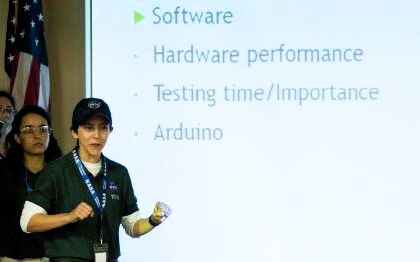
Marshall Space Flight Center · NCAS
Mission concepts, Mars probes, autonomous navigation, and a patent submission
Two NASA L'SPACE academies followed. In the Mission Concept Academy, I led GIS analysis in JMARS to identify candidate Martian crater sites for in-situ water extraction and designed the scientific payload for a kinetic impactor cryoprobe, contributing findings to the mission's Preliminary Design Review.
In the NPWEE Academy, I performed systems architecture work for an autonomous navigation system, leveraging astropy astronomical catalog data to compute spacecraft orientation from star field geometry. The design was submitted as a patented technology to NASA Technology Transfer, with the concept validated through a Unity 3D prototype. Both programs sharpened my ability to write to NASA standards and gave me firsthand exposure to how mission concepts are developed, reviewed, and submitted.
From CAD models to mission-ready AR/VR environments
Two internships at Kennedy Space Center followed, working on RMIT, VECTR, and MRET, Unity 3D AR/VR applications used for procedural training and mission rehearsal. I contributed to the RMIT 2.0 release, which leverages Blender's Python API to convert high-fidelity spacecraft CAD models from CATIA, Creo, and 3DS Max into AR/VR-compatible formats. I integrated RMIT with VECTR and MRET, enabling CAD pipelines to feed directly into SLS/Artemis crew training environments, Roman Space Telescope engineering workflows, and OSIRIS-REx mission operations. I authored the end-user documentation that handed RMIT off to operators across KSC.
Contributing to tools that supported several mission operations gave me a sense of what it means to write software that matters.
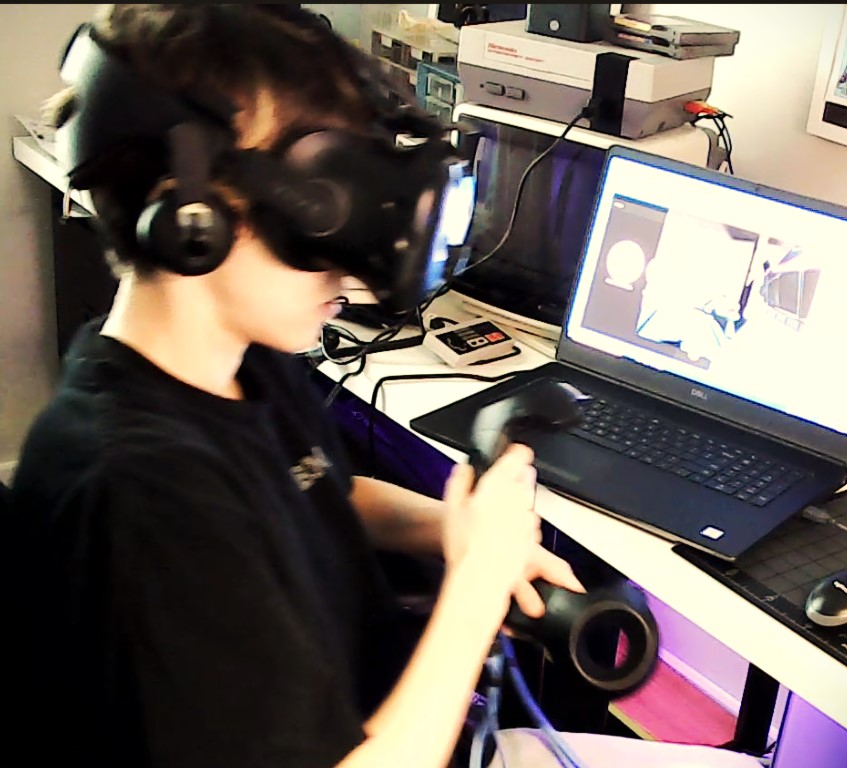
Kennedy Space Center · AR/VR
Defense full-stack by day, autonomy by night
Three years into KBR, I've shipped Angular and Spring Boot services, fine-tuned transformer models for domain-specific document extraction, and run a Jenkins/Docker/Kubernetes deployment pipeline as the daily reality. The portfolio above is what I do in my spare time to advance my skills in AI-driven GEOINT and embedded autonomy.
Resume
View full resume
Nine roles across NASA, KBR, and other engagements. B.S. Computer Science, Fort Hays State University.